 Used under the Creative Commons license through Flickr. Photography by Ian Kennedy. Everyone loves a bargain, right? Right! I do, too. There are plenty of bargains to be found when it comes to baby carriers. Some bargains are found on buy/sell/trade boards, and others at consignment shops. Some are on the clearance racks at the big box stores, and others are from flash sales at online specialty stores. There is a type of bargain baby carrier that is really NOT a good deal, and that is the copy/knockoff or fake carrier. These come in two types: one that kind of looks like a specific brand carrier but is not labeled as that brand (copy/knockoff), and one that looks like, and is labeled as that specific brand, trying to pass for that carrier (fake). Many of these copies and fakes can be found on Amazon, eBay, or the Chinese e-commerce site Alibaba. Major brands that tend to be copied are Ergo, Freehand (a brand of mei tai that is no longer produced), Beco, Hotslings, Tula, Lillebaby, Bjorn, Moby, and more. Ergo is by far the most frequently copied and there are many FAKE Ergos out there. They are now copied so closely that some of them are impossible to tell the difference. The only ways to ensure you aren't buying a fake Ergo are to buy new from an authorized retailer (Ergo maintains information about these on their site), or contact Ergo with the information on the tag if you are buying used. It pays to be cautious. The fakes are everywhere, and sometimes they are being re-sold by people who do not realize they are fake. Swap boards, consignment stores, and garage sales have turned up fake carriers, and it is always a sad day when someone is excited about their new carrier, only to find out that it is a fake, and essentially worthless. Then, they are without a carrier, and often out the money they paid for the fake. You might be thinking: "well if it looks like an Ergo, and functions like an Ergo, who cares?" Here's why you should care and beware:
If you are looking for a carrier and feel like a fake or copy is your only option due to budget, please reconsider, for the health and safety of your baby and your family. There are a number of authentic carriers that are comparable in price to a fake or copy, and I will highlight these in an upcoming blog post. For further reading on fakes and copies, please see: http://blog.ergobaby.com/counterfeits/ http://babycarrierindustryalliance.org/2013/02/fake-carriers-warning/ https://bwichicagoland.wordpress.com/2012/08/07/the-problem-with-counterfeits/ http://www.reallywhatwerewethinking.com/2012/08/ Put your mind (and baby) at ease, and only buy authentic carriers!  Used under the Creative Commons license through Flickr. Photography by Sarah Lewis.
2 Comments
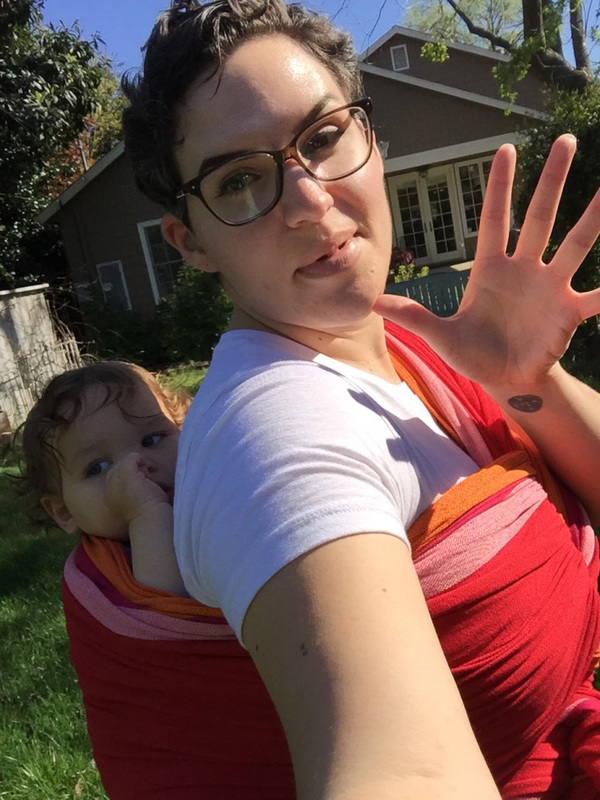 [Images: Elena in a one-shoulder Taiwanese carry, taking a selfie amid a very green grass and with a small black dog in the background. In the next photo, Elena and baby are signing “MAMA.”] Used with permission from WrapInASL One of the ways that babywearing instruction and information is obtained is through video tutorials about using carriers. For hearing caregivers, this usually works well. But for caregivers with hearing loss, this modality is lacking. Often, the instruction is verbal and there is no captioning of any type. While the visual information is helpful, crucial information is lost from the narration. Deaf or Hard-of-Hearing caregivers have had difficulty finding resources to learn carrying. This post will highlight the resources available to Deaf and Hard-of-Hearing caregivers. Wrap in ASL - Elena Ruiz maintains a lovely blog with reviews and photos, a Facebook page and Instagram, and also a babywearing-focused YouTube channel with all videos in ASL. She is an active advocate for Deaf babywearers. Deaf Babywearing Community - this Facebook group is a group exclusively for Deaf, Hard-of-Hearing, DeafBlind, and DeafDisabled parents and caregivers to learn about babywearing. Deaf Babywearing Access - this Facebook group is a space where Deaf, DeafBlind, DeafDisabled, and Hard-of-Hearing babywearers and their hearing supporters can address access to babywearing information at meetups, conferences, consultations, and more. Amy Wraps Babies - All videos at this YouTube channel are fully captioned. Wrapping Rachel - All videos at this YouTube channel are fully captioned. Wrap You In Love - This educator maintains a comprehensive website (with reviews, photos, tutorials, and more) and a YouTube channel with captioned videos. For further search options, the Deaf babywearing community uses the hashtag #DeafAndWearing on social media. If you know of any more resources that you think should be included on this list, please leave a comment, or contact me and I will add them!  [Image: Light turquoise and black color-blocked image with central text in white font. Text reads: #DeafAndWearing.] Used with permission from WrapInASL  Photo by Brittney Hogue, used with permission from Regina Keefe 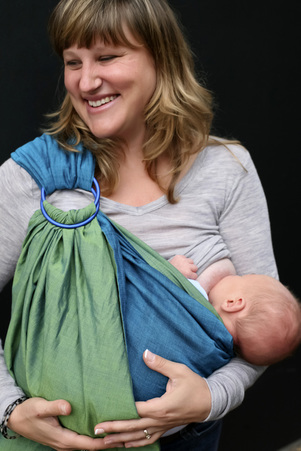 Used under the Creative Commons license through Flickr. Photography by hugabub Used under the Creative Commons license through Flickr. Photography by hugabub "I've heard you can breastfeed while babywearing. Tell me what I need to do!" Feeding while wearing is a very common topic. Babies spend an awful lot of their young lives eating! It is technically possible to feed a baby in just about any type of carrier. However, it is often a skill that must be learned and practiced, by both wearer and baby, so it is not as easy as one might hope. A number of factors can affect how quickly you might learn this skill, or what carriers might work for you, including breast shape and size, body type, and baby's feeding position preferences. Here are some guidelines that will hopefully help you learn this skill. Safety first! Open Airway: Make sure baby can breathe, and his face is not covered by the carrier or pressed into your breast tissue, if you are breastfeeding. Listen while he eats, for any unusual sounds like grunting, snoring, or other atypical feeding noises. These can signify he is having problems breathing and needs to be repositioned (don't forget to check to be sure his chin is off his chest). Visible: If you use part of the carrier (perhaps the tail of a ring sling), or a blanket or cover for privacy, cover yourself but do not cover baby's face. If his face is covered, he is re-breathing the air he exhales which can be very dangerous. Close enough to kiss: Do not keep baby in the (usually lowered) breastfeeding position after he is done breastfeeding, even if he is asleep. Move him back up to the higher, upright "visible and kissable" position, and re-adjust the carrier. First Steps Ensure that you learn and refine each skill (feeding/breastfeeding, and babywearing) separately and are competent at each, before you combine them. The breastfeeding relationship should be well-established, with good latch and transfer of milk. A very new baby might sleep deeply while in a carrier and miss feedings, so be aware of your baby's feeding needs. Clothing (for breastfeeding) This all depends on your preference. Many mothers prefer a shirt with a neckline that allows them to lift the breast over the top. Others prefer the "two shirt" method, and with a carrier, you will want to lift the top shirt a bit as you are putting the carrier on (otherwise, the top shirt may get caught in the carrier, making it difficult to lift). Expectations You should know that you will likely not be hands free feeding for a while, even with baby in the carrier. You will probably have a hand supporting your baby's head (especially if baby is young), and possibly have another hand supporting your breast. If you are using bottles, you will have to use a hand to hold the bottle. Over time, as your baby grows, and with practice, you may gain a hand or two back. The biggest gain you'll get is the ability to move and feed without bearing baby's full weight in your arms. Mechanics For breastfeeding: In most every carrier, you will lower the baby by loosening the carrier a bit and sliding baby down your body, until baby's head is at breast level. It is also possible to breastfeed with baby in a slightly reclined position, but this can make repositioning baby afterwards a bit more complicated. For bottlefeeding: Generally, it works well to reach a hand under a strap (for buckle carriers or mei tais) or pass (for wraps) and grasp the bottle, then feed. If baby prefers to eat in a specific position, you can shift them in the carrier to be in this position, remembering to reposition when baby is done. Videos: Breastfeeding in the Ergo. (Similar to how you'd feed in a Tula, Bjorn, Boba, etc). Breastfeeding in a wrap. Breastfeeding in a mei tai. Breastfeeding in a ring sling. If you would like some in-person assistance with learning this skill, please attend a local babywearing group meeting, or contact a babywearing educator for private and personalized help. If you do not have access to either of these resources, consider asking at a breastfeeding group, keeping in mind the safety information discussed above. Sources: http://www.bwiaustin.org/breastfeeding-while-babywearing/ http://beltwaybabywearers.blogspot.com/2011/06/babywearing-triplets-feeding-in-carrier 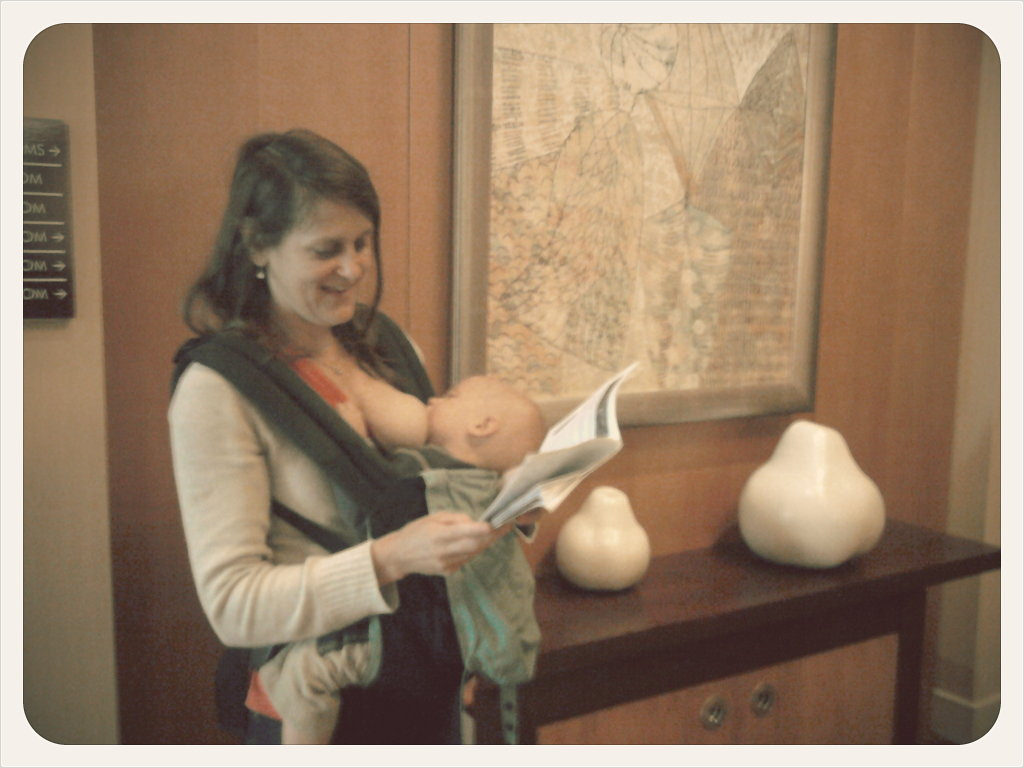 Used under the Creative Commons license through Flickr. Photography by kellyhogaboom 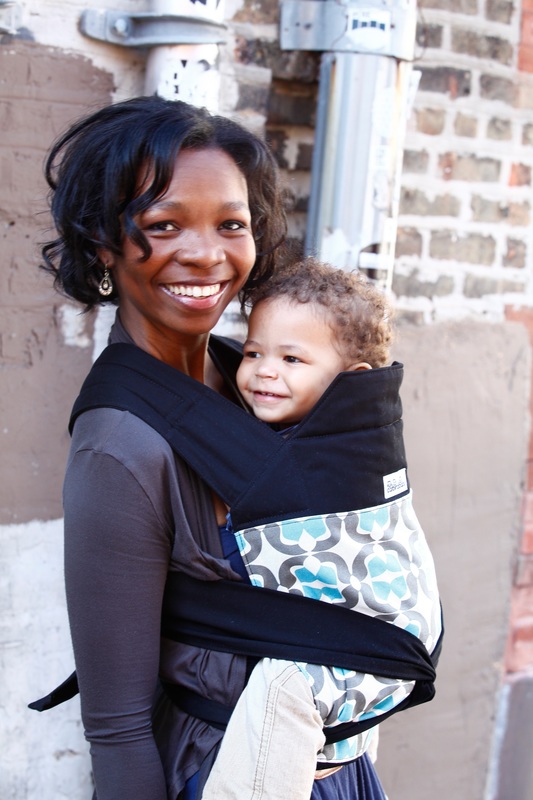 Catbird Baby mei tai in a front carry. Photo used with permission from Catbird Baby. What if I told you that there was a wonderful type of carrier that is:
Would you jump at the chance to try it? Guess what? There is! It is the mei tai. The What? A mei tai (pronounced "may tie"), simply put, is a baby carrier constructed of a panel (often rectangular) with four straps, one strap at each corner. Two of the straps are tied around the waist, and two of the straps go over the shoulders, cross the wearer's back, and back around to the front, where they may be tied. For a back carry, they may go over the shoulders, cross the front (some men prefer this way) or straight down like backpack straps, back across the baby's back, and back around to the front where they are tied off. The mei tai originates from China, and this source tells us the name means "to carry on the shoulders with a strap." Adjustable, Easy, and Versatile Mei tais are much more adjustable than buckle carriers, which are more "fixed." For a newborn or small baby, you can safely and easily narrow the bottom of the panel, if needed to provide a comfortable seat without spreading baby's legs too far. You can roll the waist to make a shorter panel so baby isn't swallowed by the panel like he would be in a standard size buckle carrier. You can change the angle and function of how the straps cross over and support your baby so you can easily and comfortably trade a mei tai between wearers. Mei tais are generally easier to use than wraps and ring slings, and fairly comparable to buckle carriers for ease of use. Mei tais can be used as baby grows. You can change how the straps support your baby. If you want to venture away from front carries, you can do a hip carry that is generally more comfortable than doing one with a buckle carrier, and you can do a back carry high enough to allow baby to peek over your shoulder while awake, or to rest his head on the back of your neck when he falls asleep. If you want to have only one baby carrier for newborn through toddler days, this might be a great option for you! Types and Brands of Mei Tais There are very simple mei tais, made from canvas or other heavy cloth, with minimal padding. Some mei tais have padding at the waist or on the shoulder straps, and some have wide straps that mimic the function of a woven wrap. These are typically made with woven wrap material, though occasionally linen or other fabric that performs similarly. You will occasionally see a few extra features on both types, including headrests, sleep hoods, toy loops, infant inserts, cinching mechanisms, and more. Some of the more commonly available and popular simpler canvas mei tais are: Catbird Baby, BabyHawk, and Infantino Sash. Catbird Baby and BabyHawk are generally described as more comfortable and able to be used longer than the less expensive Infantino. All of them function the same and are perfectly safe when used correctly. There are a variety of easily obtained mei tais made from wrap material on the market. Currently, these include: Soul's Soul Tai, Girasol's MySol, Didymos' DidyTai, Babylonia USA's BBTai, Fidella's Fly Tai, Lenny Lamb, Chimparoo, Topatop, BaBySaBye. and more! The price point on these is comparable or a bit higher than the higher quality canvas mei tais. Many of these have wide straps that can provide extra support around your shoulders and under baby's bottom. In summary, if you are looking for a carrier that is adjustable from newborn through toddler wearing, adaptable to various body types, and fairly easy to use comfortably, consider a mei tai! 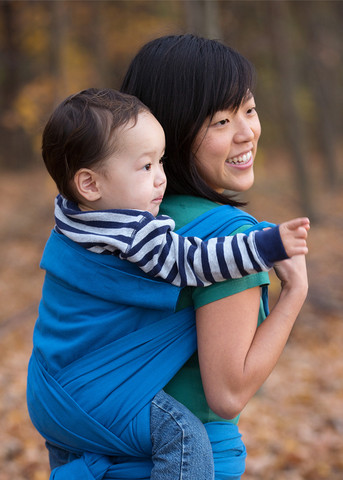 BBTai in a back carry. Photo used with permission from Babylonia USA.  Julia Walker, World on My Shoulders founder. Photo taken by Lehi Snider, age 4. Think about all of the benefits that babywearing brings to you, your child, and your family. The comfort, the confidence, and convenience that make life more pleasant, easier, tolerable, livable. Parents everywhere who wear their babies agree with you. Babywearing makes life better for everyone. For some mothers and babies, however, babywearing is something more. It can bring comfort, connection, and the ability to get through daily life when life is at its toughest. One tough situation that faces some families is family violence, specifically intimate partner violence. There are a range of effects on the mothers and children who survive, including physical injury, emotional trauma, cognitive distortions, complete separation from social or family support, instant and extreme financial problems, and lasting neurological effects of witnessing and experiencing trauma, especially for babies and children. Babywearing, when utilized carefully, is a tool that can assist some mothers and children who face these obstacles. One woman started listening Julia Walker is a babywearing mom who decided to do something to help moms and their children who have recently left family violence and are living in the shelter system. She had volunteered as a co-leader with her local babywearing group, and while helping members learn to wear, discovered that some were, like her, rebuilding their lives after fleeing partner violence. Word spread that she was teaching these women to use carriers, and she quickly exhausted her personal resources. She developed the organization World on My Shoulders to partner with manufacturers, community activists, and other caring individuals to collect carriers and raise funds to sustain and expand the scope of this unique project. The story of World on My Shoulders Julia graciously agreed to answer some questions about WoMS to share about the story, mission, and impact of the organization, and how you can help! Q: Can you tell us a little about what you have witnessed about how babywearing helps some moms and babies who have experienced family violence? In what ways can babywearing support some of these families? A: I experienced family violence so I will answer from the survivor perspective. Wearing helped me in several ways when I fled. I was 34 weeks pregnant and had a one year old when I was severely beaten and finally left. The incident broke my glasses and cracked my orbital and several ribs so I was unable to drive and had to wear to walk. We were both shaken so for weeks after that last attack, I was unable to put my elder child down out of fear. I had a moderate sized stash, six carriers, and the money I made reselling most of those gave me what padding I had while travelling through the shelter system on the way back to my safe place. Luckily my stays in shelter were short and I primarily happened across some very nice facilities but that isn't the reality for many and wearing can help keep children feeling safe while helping the caregiver to accomplish the daily tasks required to stay in many facilities. Q: What types of evidence-based practices do you use in working with this vulnerable population? A: My evidence based experience is lived experience, knowledge of the communities I serve, and the listening to the needs of the people I am helping. The goal is filling a void beyond shelter. By giving people a lifelong tool, an escape from their trauma, and a connection to a broader community of babywearers that has replaced the community model that has disappeared in mainstream society. Studies have concluded that babywearing can aid trauma victims by decreasing anxiety and depression for the wearer and the wearee. I have plans for continuing education that will aid me in better understanding infant development and anticipate that will help the wearers also. Q: Women and children who have experienced the trauma of family violence are often at risk for being triggered by close physical contact. What mental health professionals does WoMS consult or partner with to ensure your outreach efforts are based on trauma-informed practices? A: All of us are survivors of family violence, either as children witnessing and suffering from the effects or like myself, adult victims with children. Coupling our basic skills as babywearing educators seeking to maintain bodily autonomy for all that we help with our personal experiences within the system, we all have heightenened sensitivity to those freshly fleeing. Q: Women leaving family violence situations and living in shelters or other transitional housing often are living in very dirty conditions and with minimal or no access laundry facilities or supplies (with which to wash cloth carriers). How do you address this barrier? A: With the locales that we worked in so far, this hasn't been an issue, though I primarily ask manufacturers for the easycare items in their catalog. Soul Slings sent us some all cotton wraps and ring slings and BabyloniaUSA sent some BBTais which are extremely easy to spot clean along with BBSlens and wraps. Q: What cities or community is WoMS currently helping? Who is helping and how? A: Right now, I cover Texas, primarily the eastern portion of the state. Autumn Brundige is in SE Oklahoma and is the closest to myself. Hess Stinson is in the greater DC area and Anastasia West covers NYC, particularly the Bronx. I also have an educator in Houston, Angelique Geehan, who will be assisting with our first full sized in person class July 2016. Q: What are the "next steps" of WoMS? A: Right now I am preparing to speak about WoMS at WEAR (a babywearing conference) in Chicago in May. The class in Houston in July 2016 is next then expanding our library by purchasing from some of the companies that already donated: BabyloniaUSA and Soul Slings being priority. We are also in the process of building a webstore with homemade goods. Then, we can gather resources to help us pursue nonprofit status. Q: How can others help? What kind of support do you need to continue your mission? A: Finances are our main barrier. We need money to ship carriers to those who live far from any existing WoMS chapters. We have a paypal specifically for WoMS that is generally empty. We need supplies for our webstore, most of which can be purchased at any craft store. We all are doing this on a volunteer basis so helping us cover the costs for our continuing education would be great also. Also, WoMS is one of my jobs. Recently I started doing professional babywearing consultations in an attempt to fundraise for my family to survive and for WoMS expansion but jobs are far and few between until word of mouth spreads more. How can you help? As you prepare to celebrate Mother's Day with your babies, little and big, consider supporting the mothers and babies who are helped by World on My Shoulders, through spreading the word, sending good wishes or prayers for success, purchasing an item for sale from the webstore on the WoMS site (scheduled to open May 13th. 2016), or making a donation. |
AuthorBeth. The babywearing lady. Archives
May 2017
Categories
All
all content
copyright 2016 Beth Secrist All photos used under the Creative Commons license through Flickr. Photography by: littletuesday12 |
 RSS Feed